Women's Health
BPC-157: Benefits, Uses, and What to Know
If you have spent any time in recovery, fitness, or longevity circles lately, you have probably heard BPC-157 mentioned in the same breath a

Reviewed by

.avif)
.avif)


If you have spent any time in recovery, fitness, or longevity circles lately, you have probably heard BPC-157 mentioned in the same breath as faster healing and fewer nagging injuries. It is one of the most searched peptides on the internet, and also one of the most misunderstood. This guide walks through what BPC-157 actually is, what the research does and does not show, how it is used, and the one decision that matters most if you are considering it.
BPC-157 is a synthetic peptide, a short chain of amino acids based on a protein found in the stomach, that has been studied for its role in healing and tissue repair. The letters stand for "body protection compound," a nod to the gastric protein it is derived from. Like other peptides used in a clinical setting, it works as a signaling molecule rather than a drug that overrides your system, which is part of why it has drawn so much interest in recovery. If peptides are new to you, it helps to start with the basics of what is peptide therapy before going deeper on any single one.
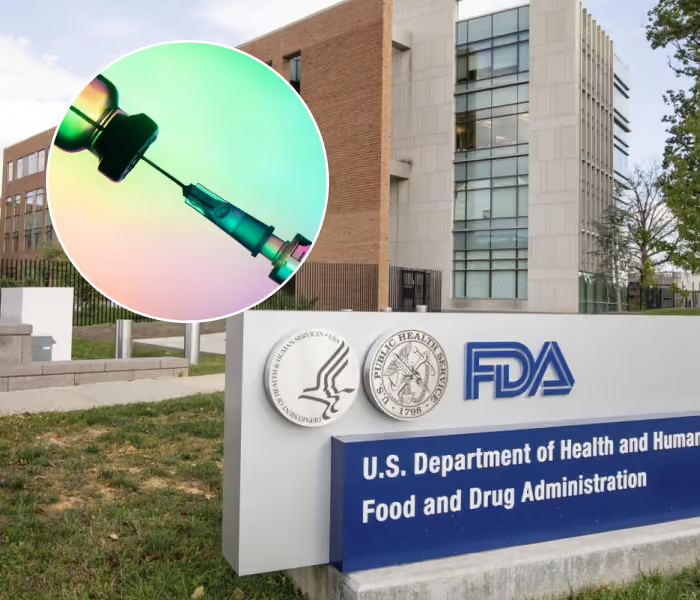
One thing to know up front: BPC-157 is not FDA-approved. Where it is available, it is typically compounded and used under the guidance of a licensed medical provider, not bought off a shelf. That status matters, and we come back to it below.
Most of the interest in BPC-157 comes from preclinical research, largely animal studies, suggesting it may support the body's own repair processes. The areas researchers have looked at most include soft-tissue and tendon recovery, the gut and digestive lining, and the inflammatory response. In those models, BPC-157 has been associated with supporting blood-vessel formation and tissue healing, which is the mechanism people point to when they describe it as a "recovery" peptide.
It is worth being clear-eyed here. Much of the evidence is early and has not yet been confirmed by large, high-quality human trials. That gap between promising early research and proven human outcomes is exactly why supervision matters and why honest claims should stay measured. Anyone promising guaranteed results is getting ahead of the science.
Based on how it has been studied, people explore BPC-157 to support:
Recovery from training, soreness, and soft-tissue strain.
Tissue and tendon repair after overuse or minor injury.
Gut and digestive comfort.
A calmer inflammatory response.
These are areas of active study, not promises. Individual responses vary, and a licensed medical provider can tell you whether the current research supports considering it for your specific situation, or whether a different approach makes more sense.
BPC-157 comes in two main forms: an injectable, given subcutaneously, and an oral capsule. The injectable is more common in recovery-focused protocols, while the oral form is sometimes chosen for gut-focused goals or by people who would rather not inject. Some providers also use a localized approach near the area of concern, again only where appropriate.
Which form fits you, if any, is a decision for your provider based on your goals and history, and it is one piece of a supervised peptide therapy plan rather than a standalone purchase. The form, the schedule, and whether BPC-157 belongs in your plan at all are clinical choices, not defaults.
In the research and clinical use to date, BPC-157 is generally described as well-tolerated, with the most commonly mentioned issues being mild, such as irritation at the injection site or mild fatigue for some people. Because the long-term human safety data is still limited, a good provider treats it conservatively, starts thoughtfully, and monitors how you respond.
The bigger safety issue is usually not the peptide itself but the source. Unregulated "research chemical" BPC-157 sold online comes with no provider, no purity or potency testing, and no accountability for what is actually in the vial. The FDA has also identified BPC-157 among bulk drug substances that may pose significant safety risks in compounding. That is where the real risk lives, and it is the risk supervised care is built to remove.
This is one of the most searched questions about BPC-157, and the honest answer is that dosing is individualized and should be set by a licensed medical provider, not copied from a forum thread or a seller's website. The appropriate amount depends on your goals, the form, and your health history. We do not publish a dosing protocol here on purpose. Self-dosing an unregulated peptide based on internet numbers is exactly the gamble that supervised care is designed to remove.
BPC-157 is not FDA-approved, and the FDA has taken steps that limit its use in compounding. In practice, that means access is changing and depends on the pharmacy and the provider, and it may differ over time and by location. A reputable provider will be transparent about its regulatory status, weigh whether it is appropriate for you, and only work within what is currently allowed. If a seller is not discussing any of this and simply wants to ship you a vial, treat that as a signal to walk away.
You will often see these two peptides mentioned together. BPC-157 is studied more for localized repair and gut support, while TB-500 is studied more for broader muscle and connective-tissue recovery. They are sometimes combined in recovery blends because the mechanisms researchers have explored are different and potentially complementary. That said, "stacking" peptides is not something to improvise. Whether either one, or a blend, is appropriate is a provider decision informed by what peptides are and how they actually work, not a default setting.
People who look into BPC-157 are often active adults dealing with slow recovery, a nagging soft-tissue issue, or gut discomfort, who want a supervised option beyond rest and over-the-counter products. It is not right for everyone. Pregnancy, certain medical conditions, and some health histories can all make it inappropriate, which is one more reason the starting point is a clinical conversation and a review of your history rather than a checkout cart. A provider's job is partly to tell you when the answer is no.
If you are considering BPC-157, the single most important choice is how you get it. Doing it through a licensed medical provider and a pharmacy that tests for purity and potency, as part of a supervised plan, is a fundamentally different thing from ordering an unlabeled vial off a website. That one decision is the difference between a monitored plan with someone accountable for your care and a roll of the dice with your health. If recovery is the goal, start by talking it through, not by guessing.
What is BPC-157 used for?
It is studied for recovery, tissue and tendon repair, gut support, and inflammation. The research is mostly early and largely preclinical, so a licensed medical provider should weigh whether it fits your goals.
Is BPC-157 safe?
In clinical use it is generally described as well-tolerated, but safety depends heavily on getting it through a provider and a pharmacy that tests for purity, not from an unregulated online seller. Long-term human data is still limited.
Is BPC-157 FDA-approved?
No. It is not FDA-approved and has faced restrictions in compounding. Access depends on the provider and pharmacy and can change over time.
How is BPC-157 taken?
As a subcutaneous injection or an oral capsule. Your provider recommends the form, if any, based on your goals.
What is the right BPC-157 dosage?
Dosing is individualized and should be determined by a licensed medical provider. We do not recommend self-dosing from online sources.
How long does BPC-157 take to work?
It varies by person and goal, and the human evidence is limited. A provider can set realistic expectations and adjust based on how you respond. Individual results vary.


.avif)

.avif)